LLM Comparison Cheat Sheet
How to Choose the Right Model Family
TL;DR:
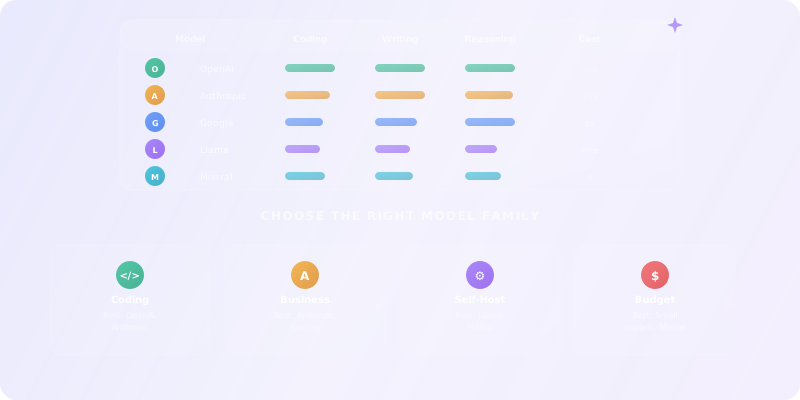
This guide compares six major LLM families — OpenAI, Anthropic, Google, Llama, Mistral, and small/mini models — across strengths, limitations, pricing, and context length. You get scenario-based recommendations, a lightweight evaluation framework, and a decision tree. The goal is not to crown a winner but to help you pick the right model for your specific use case.

How to think about LLM choice (before you look at names)
Before you compare model families, get clarity on these five dimensions. Your answers here determine which trade-offs matter most.
Use case risk level
Is this powering an internal assistant, a blog helper, or a mission-critical customer feature? How bad is it if the model is wrong, vague, or slow?
Context length you actually need
Do you mostly send short prompts and chat, or do you routinely feed full PDFs, codebases, or long email threads into the model?
Data sensitivity and compliance
Can your content leave your infrastructure? Do you need on-prem, VPC, or strict region boundaries?
Budget and scale
Are you experimenting with a few thousand tokens per day, or serving millions of requests per month? Peak quality or price-performance?
Ecosystem and integration needs
Which cloud and tools are you already invested in? Do you need SDKs and plugins that "just work" without heavy integration work?
Model Families at a Glance
OpenAI FamilyClosed-weight
Core strengths
- Strong general reasoning, code, and writing
- Broad ecosystem support and many integrations
- Mature tooling for function calling, streaming, and evaluation
Key limitations
- Closed weights — no self-hosting or fine-tuning of base model
- Not the cheapest at very high volume
- Vendor lock-in risk
Best-fit scenarios
High-stakes chat, coding assistants, customer support, AI agents that must "just work".
Pricing profile
Mid–high per token; attractive quality-for-price at small–medium scale.
Context range
Mid to high: comfortably handles long chats and medium-sized documents.
Anthropic FamilyClosed-weight
Core strengths
- Very long context windows — among the largest practical on the market
- Excellent summarization and analysis of large documents
- Conservative, safety-conscious behavior
Key limitations
- Access and features vary by region and partner
- Smaller ecosystem than OpenAI
- Fewer third-party integrations
Best-fit scenarios
Research assistants, contract and policy analysis, knowledge-base chat over large corpora.
Pricing profile
Mid-tier pricing; appealing when long context replaces multiple shorter calls.
Context range
Very high: among the largest practical context windows on the market.
Google FamilyClosed-weight
Core strengths
- Tight integration with Google Cloud and Workspace
- Strong multimodal capabilities
- Good for collaborative workflows
Key limitations
- Ecosystem still maturing
- UX varies between products
- Regional differences in availability
Best-fit scenarios
AI features inside Docs, Sheets, Slides, and Gmail; GCP-hosted apps; education and productivity tools.
Pricing profile
Competitive mid-tier pricing, with generous bundled usage in some Workspace plans.
Context range
Mid to high: suitable for long documents and mixed-media interactions.
Llama FamilyOpen-weight
Core strengths
- Open weights — supports self-hosting and fine-tuning
- Strong performance when well-served
- Vibrant open-source ecosystem
Key limitations
- You are responsible for infra, scaling, and safety
- Base models can lag top closed systems without tuning
- Requires ML engineering capability
Best-fit scenarios
Privacy-sensitive apps, regulated industries, products needing customization and model control.
Pricing profile
Infra + operations cost instead of per-token API; often cheaper at scale with serious infrastructure.
Context range
Varies by size; from small contexts up to moderately large windows.
Mistral FamilyOpen-weight & Hosted
Core strengths
- Very good cost–performance ratio
- Efficient serving and modern architectures
- Solid multilingual support
Key limitations
- Smaller ecosystem and brand awareness vs. largest US providers
- Model quality varies by release
- Fewer enterprise integrations
Best-fit scenarios
High-volume APIs, European deployments, multilingual chat and summarization.
Pricing profile
Generally low–mid per token; compelling for cost-sensitive workloads.
Context range
Small to mid-range contexts, with some extended-context variants.
Small / "Mini" ModelsVarious
Core strengths
- Extremely fast and cheap
- Some run on-device (mobile, edge)
- Ideal for latency-sensitive UX
Key limitations
- Limited reasoning depth
- Smaller context windows
- Not suited for complex multi-step tasks
Best-fit scenarios
On-device assistants, autocomplete, tagging, light rewriting, UI helpers.
Pricing profile
Very low marginal cost; sometimes bundled or free inside products.
Context range
Small to modest context windows, focused on short prompts and outputs.
Practical Recommendations by Scenario
Product & engineering teams shipping user-facing features
Priority: Reliability, quality, and predictable behavior.
You are likely building:
- In-app copilots for your SaaS product
- AI-powered search, support, or onboarding flows
- Multi-step agents that call APIs and tools
Recommendation
Tips:
- Budget for per-token costs at your expected scale.
- Track latency and quality over time — don't assume "latest" always equals "best" for your use case.
Legal, medical, finance, and other high-sensitivity domains
Priority: Control, privacy, and auditability.
You are likely building:
- Client data that cannot leave your infrastructure
- Sector-specific regulation (HIPAA, GDPR, financial conduct)
- Need to explain system behavior to auditors or regulators
Recommendation
Tips:
- You gain the option to deploy inside your own cloud with your own logging and access controls.
- You take on responsibility for infrastructure, safety filters, red-teaming, and ongoing evaluation.
Knowledge work: research, analysis, and summarization
Priority: Long-context understanding and accurate synthesis.
You are likely building:
- Reading long research reports or legal documents
- Synthesizing notes from many meetings and emails
- Building internal research copilots for your team
Recommendation
Tips:
- If your documents fit into a single context window, you can avoid building a retrieval layer.
- If they don't, invest in a solid retrieval pipeline and pick a model known for robust reasoning.
Collaboration, productivity, and education
Priority: Seamless integration and a low barrier to entry.
You are likely building:
- Workflows around office suites, email, and shared documents
- Supporting non-technical teams who need AI where they already work
- Schools or universities with mixed device and account setups
Recommendation
Tips:
- What matters here is not just model quality but how easily you can deploy AI into existing workflows.
- Check licensing and data-use policies carefully for educational or institutional environments.
Cost-sensitive, high-volume, or latency-critical systems
Priority: Price-performance and responsiveness.
You are likely building:
- Large-scale content transformation (classification, tagging, rewriting)
- Chatbots with very high traffic but simple dialog patterns
- On-device or near-device assistants that must feel instant
Recommendation
Tips:
- Use a cheaper, faster model as a first pass (routing, classification), and only call a more expensive model for complex cases.
- This "router" pattern can cut costs 50–80% without meaningful quality loss on simple tasks.
How to Run a Simple LLM Evaluation
Before you standardize on a model family, run a small, structured evaluation. This lightweight process, repeated occasionally, is more valuable than chasing every new model announcement.
Step 1: Define 10–20 representative tasks
Real prompts from your product or team, not synthetic benchmarks. Include edge cases and messy inputs.
Step 2: Test at least two families
For example: OpenAI vs Anthropic, or OpenAI vs Llama/Mistral. Same prompts, same evaluation criteria.
Step 3: Score on three axes
Quality (correctness, relevance, style), Robustness (edge cases, messy inputs), and Cost & Latency (tokens used, time to respond).
Step 4: Look for "good enough", not perfection
If two families perform similarly, consider ecosystem fit, integration effort, and long-term flexibility.
Step 5: Document the decision
Write down why you chose a given family and in what situations you might revisit that choice.
LLM EVALUATION SCORECARD — [Project Name] — [Date]

TASK SET: [describe the 10–20 representative tasks]

═══════════════════════════════════════════
MODEL A: [name + version]
Quality (1–5):     ___
Robustness (1–5):  ___
Cost/Latency:      ___ tokens avg, ___ ms avg
Notes:
-
-

═══════════════════════════════════════════
MODEL B: [name + version]
Quality (1–5):     ___
Robustness (1–5):  ___
Cost/Latency:      ___ tokens avg, ___ ms avg
Notes:
-
-

═══════════════════════════════════════════
DECISION: [which model and why]
REVISIT WHEN: [conditions that would trigger re-evaluation]
Decision Tree: A Simple Starting Point
“I need self-hosting, strict data control, or deep customization”
→ Start with open-weight families (Llama, Mistral) and invest in infra and safety.
“I need strong general-purpose reasoning and broad ecosystem support”
→ Start with OpenAI, and consider Anthropic for long-context tasks.
“I live in Google’s productivity stack and care about multimodal”
→ Start with Google’s family, especially for Docs/Sheets/Slides integrations.
“I’m optimizing for cost and throughput on relatively simple tasks”
→ Start with Mistral and smaller models, plus a routing strategy.
Living document
Run a Mini LLM Evaluation
- 1Pick one real task from your current project (e.g., summarize a support ticket, generate a code snippet, draft an email).
- 2Run the same prompt through two different model families (e.g., OpenAI and Anthropic, or OpenAI and a Llama-based API).
- 3Score each on quality (1–5), robustness (does it handle edge cases?), and note the response time.
- 4Write down which model you’d pick for this task and why. Would your answer change at 10x the volume?
Ready to Apply What You Learned?
AI Critical Thinking
Build the evaluation skills to cut through vendor hype.
Start LearningTest Your Knowledge
Test your understanding of LLM families, trade-offs, and model selection.
Loading quiz...
Key Insights: What You've Learned
LLM choice is not about finding the "best" model — it’s about matching model strengths to your specific use case, risk level, data sensitivity, budget, and ecosystem.
Six major model families cover the spectrum: OpenAI and Anthropic for strong closed-weight reasoning, Google for productivity integration, Llama and Mistral for open-weight control and cost efficiency, and small models for speed and on-device use.
Build the habit of structured evaluation: define representative tasks, test at least two families, score on quality/robustness/cost, and document your decision. This process matters more than any single model choice.