AI Readiness Framework
Assess Your Organization in 7 Dimensions, Act on the Gaps
TL;DR:
This framework scores your AI readiness across 7 dimensions on a 1–5 maturity scale. You get a scoring template, a heatmap approach, and a 90-day action plan. The goal is not to reach “Level 5” everywhere — it's to know where you are, decide where you need to be, and close the gaps that actually matter for your business.

Who this framework is for
This framework is for founders, CTOs, product leaders, and department heads who need to make informed decisions about AI adoption — not just pick tools, but build the organizational capability to use them well. It's also useful for consultants and advisors who need a structured assessment they can run with clients.
Founders & CEOs
CTOs & Tech Leads
Product Leaders
Consultants & Advisors
The 7 Dimensions of AI Readiness
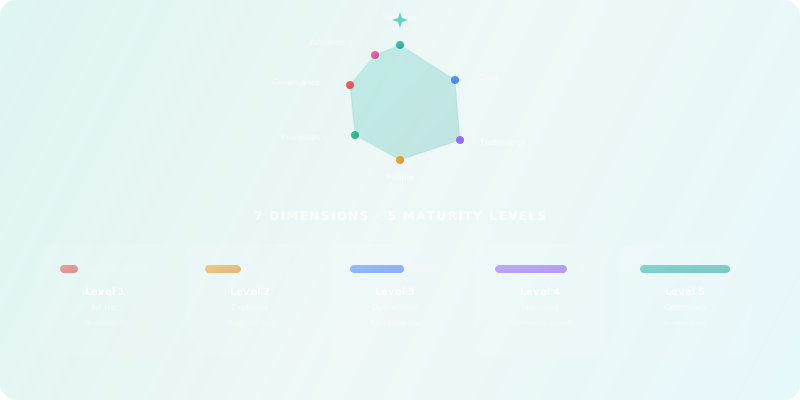
Each dimension gets a score from 1 (Ad hoc) to 5 (AI-Native). The goal is not to max out every dimension — it's to understand where you stand, where you need to be for your specific context, and which gaps are blocking progress.
1Strategy & Value
Clear AI vision aligned with business OKRs, prioritized use cases with ROI hypotheses, executive ownership and budget.
Assessment questions
- Is there a documented AI strategy aligned with business objectives?
- Are use cases prioritized with estimated ROI?
- Is there executive ownership and dedicated budget for AI initiatives?
- Are AI outcomes measured against business KPIs?
- Is there a portfolio review process for AI investments?
2Data & Governance
Data quality, accessibility, documentation. Data governance (owners, lineage, retention). Compliance (GDPR, AI Act, sector rules).
Assessment questions
- Is your data documented, catalogued, and accessible to AI workloads?
- Are there clear data owners and governance policies?
- Is data quality measured and maintained systematically?
- Are you compliant with GDPR, AI Act, and sector-specific regulations?
- Can you trace data lineage from source to model output?
3Technology & Architecture
Cloud + API-first infrastructure. MLOps / LLMOps (monitoring, rollback, versioning). Security posture for AI workloads.
Assessment questions
- Is your infrastructure cloud-native and API-first?
- Do you have MLOps or LLMOps pipelines (monitoring, rollback, versioning)?
- Is your security posture adapted for AI workloads (model access, data exposure)?
- Can you deploy and update models without manual intervention?
- Do you have cost monitoring for AI compute and API usage?
4People & Skills
AI literacy across business, not just tech. In-house AI/ML/LLM engineering capability. Product managers who can own AI outcomes.
Assessment questions
- Is AI literacy spread across the organization, not just the tech team?
- Do you have in-house AI/ML engineering capability?
- Can product managers define and own AI-driven outcomes?
- Is there a training program for non-technical staff to use AI tools effectively?
- Do you have a plan for hiring or upskilling AI talent?
5Processes & Operating Model
Repeatable pipeline: ideation → experiment → deploy → monitor. Integrated change management and training. Vendor management and build-vs-buy criteria.
Assessment questions
- Is there a repeatable pipeline from AI ideation to deployment?
- Do you have change management processes for AI adoption?
- Are there clear build-vs-buy criteria for AI capabilities?
- Is vendor management structured (evaluation, contracts, exit plans)?
- Do AI projects follow a standard experiment → pilot → scale workflow?
6Governance, Risk & Ethics
AI governance board / RACI. Risk registers, impact assessments, model cards. Policies for fairness, transparency, human-in-the-loop.
Assessment questions
- Is there an AI governance board or clear RACI for AI decisions?
- Do you maintain risk registers and impact assessments for AI systems?
- Are there policies for fairness, transparency, and human-in-the-loop?
- Do you use model cards or similar documentation for deployed models?
- Can you explain AI decisions to affected stakeholders?
7Adoption & Scale
Actual usage of AI features in core workflows. Measurement of business impact (KPIs moved). Ability to scale successful patterns across teams.
Assessment questions
- Are AI features actively used in core business workflows?
- Do you measure the business impact of AI initiatives against KPIs?
- Can you scale successful AI patterns from one team to others?
- Is there a feedback loop from users to the AI team?
- Do you track adoption rates and user satisfaction for AI tools?
The 5 Maturity Levels
Apply this same scale to each of the 7 dimensions. Most organizations are not at the same level across all dimensions — and that's expected. The heatmap of scores is more useful than a single average.
Level 1 — Ad hoc
Experiments in silos, no clear strategy, no governance.
Level 2 — Emerging
Some pilots, basic data/infra, informal ownership.
Level 3 — Structured
Documented strategy, governance basics, 2–3 use cases in production.
Level 4 — Scaled
Shared platform, MLOps in place, AI embedded in key processes.
Level 5 — AI-Native
AI is core to products/operations, continuous optimization, strong governance.
Important
Scoring Template
For each dimension, rate 1–5 and capture evidence. Be honest — the value of this exercise is in the gaps it reveals, not in a high score.
Example: Strategy & Value
Evidence:
- AI roadmap for 12–18 months exists and is approved by execs
- Top 5 use cases prioritized with estimated ROI
- Budget allocated but no formal portfolio review yet
Gaps:
- No single AI owner per business unit
- ROI not measured post-launch
Actions (next 90 days):
- Assign accountable owner per use case
- Define 2–3 KPIs per use case and implement tracking
Overall AI Readiness Score
Average of all 7 dimension scores. Useful as a headline metric, but the dimension-level detail is where the action is.
Heatmap View
Plot all 7 dimensions on a radar chart or color-coded grid. Strengths and weaknesses become immediately visible.
AI READINESS ASSESSMENT — [Organization Name] — [Date]

═══════════════════════════════════════════
DIMENSION 1: STRATEGY & VALUE
Score: ___ / 5
Evidence:
-
-
Gaps:
-
-
Actions (next 90 days):
-
-

═══════════════════════════════════════════
DIMENSION 2: DATA & GOVERNANCE
Score: ___ / 5
Evidence:
-
-
Gaps:
-
-
Actions (next 90 days):
-
-

═══════════════════════════════════════════
DIMENSION 3: TECHNOLOGY & ARCHITECTURE
Score: ___ / 5
Evidence:
-
-
Gaps:
-
-
Actions (next 90 days):
-
-

═══════════════════════════════════════════
DIMENSION 4: PEOPLE & SKILLS
Score: ___ / 5
Evidence:
-
-
Gaps:
-
-
Actions (next 90 days):
-
-

═══════════════════════════════════════════
DIMENSION 5: PROCESSES & OPERATING MODEL
Score: ___ / 5
Evidence:
-
-
Gaps:
-
-
Actions (next 90 days):
-
-

═══════════════════════════════════════════
DIMENSION 6: GOVERNANCE, RISK & ETHICS
Score: ___ / 5
Evidence:
-
-
Gaps:
-
-
Actions (next 90 days):
-
-

═══════════════════════════════════════════
DIMENSION 7: ADOPTION & SCALE
Score: ___ / 5
Evidence:
-
-
Gaps:
-
-
Actions (next 90 days):
-
-

═══════════════════════════════════════════
OVERALL SCORE: ___ / 5 (average)

TOP 3 PRIORITIES (weakest dimensions):
1.
2.
3.

NEXT REVIEW DATE: [set 6 months from now]
Implementation Checklist (Quick Start)
To turn this framework into a working assessment, follow these five steps. The entire process can be completed in a single afternoon with the right people in the room.
Step 1: Create a 1-page survey
7 dimensions × 5 questions each (Likert 1–5). Use the questions from each dimension above, or adapt them to your context.
Step 2: Run it with the right people
Include leadership, tech leads, and 1–2 individual contributors per area. Different perspectives reveal blind spots.
Step 3: Aggregate and normalize scores
Average scores per dimension, build a heatmap. Where do leadership and ICs disagree? That's where the real gaps are.
Step 4: Pick 2–3 weakest dimensions
Define concrete 90-day actions for each. Don't try to fix everything at once — focus on the dimensions that are blocking your most important AI initiatives.
Step 5: Repeat every 6 months
AI readiness is not a one-time assessment. As you scale AI usage, your needs change. Re-assess regularly to stay intentional.
Common Pitfalls
Technology without strategy
Buying tools before defining use cases. You end up with expensive infrastructure and no clear business impact. Strategy & Value must come before Technology & Architecture.
Strategy without people
A beautiful AI roadmap that nobody can execute. If your People & Skills score is 1 and your Strategy score is 4, the strategy is fiction.
Pilots without scale path
Running 10 AI experiments that never graduate to production. If Adoption & Scale is consistently low, your operating model likely lacks a clear experiment → pilot → scale pipeline.
Governance as afterthought
Deploying AI in production and then asking about ethics, compliance, and risk. Governance should be part of the pipeline from day one, not a checkbox after launch.
Run a Quick AI Readiness Assessment
- 1Pick one AI initiative your organization is currently pursuing (or considering). Write down the business objective it serves.
- 2Score each of the 7 dimensions from 1–5 based on your honest assessment. Use the questions above as prompts — don't overthink it, first impressions are often accurate.
- 3Identify the 2 lowest-scoring dimensions. For each, write down one specific gap and one concrete action you could take in the next 90 days.
- 4Share your scores with one colleague who sees the organization differently (e.g., if you're in tech, ask someone from the business side). Where do your scores disagree? That's where the real conversation starts.
- 5Set a calendar reminder to re-run this assessment in 6 months. Track whether your actions moved the needle.
FAQ
How is this different from vendor AI readiness assessments?
Most vendor assessments are designed to surface gaps that their product solves. This framework is tool-agnostic — it assesses organizational capability, not product fit. The output is a prioritized action plan, not a purchase recommendation.
What if we score low across the board?
That's normal for organizations early in their AI journey. Start with Strategy & Value (define clear use cases) and People & Skills (build basic AI literacy). Don't invest in infrastructure until you know what you're building and who will build it.
Should we aim for Level 5 in every dimension?
No. Level 5 (“AI-Native”) is appropriate for companies where AI is core to the product or business model. A 50-person SaaS company might aim for Level 3–4 in most dimensions. The right target depends on your context, not on an abstract ideal.
How often should we re-assess?
Every 6 months is a good cadence. AI capabilities and organizational needs change fast. A semi-annual review keeps your strategy intentional and prevents drift.
Can this framework work for a startup?
Yes, but calibrate your expectations. A startup doesn't need formal governance boards or enterprise MLOps. Focus on Strategy & Value (are you building the right thing?), Data & Governance (is your data clean enough?), and People & Skills (can your team execute?). The other dimensions become important as you scale.
AI Strategy & Productivity Tools
Tools that can support your AI adoption journey — from analytics to automation.
ChatGPT
AI research, productivity, and conversation—smarter thinking, deeper insights.
Perplexity
Clear answers from reliable sources, powered by AI.
n8n
Open-source workflow automation with native AI
DeepL
The world’s most accurate AI translator
Grok
Your cosmic AI guide for real-time discovery and creation
Notion AI
The all-in-one AI workspace that takes notes, searches apps, and builds workflows where you work.
Ready to Apply What You Learned?
Prompt Engineering
Once your organization is ready, structure the prompts that drive AI tool effectiveness.
Start LearningTest Your Knowledge
Complete this quiz to test your understanding of AI readiness assessment and organizational maturity.
Loading quiz...
Key Insights: What You've Learned
AI readiness is not about tools — it's about organizational capability across strategy, data, technology, people, processes, governance, and adoption.
Use the 7-dimension, 5-level framework to score where you are, identify the gaps that matter most, and define concrete 90-day actions for your weakest dimensions.
The right maturity level depends on your context. Re-assess every 6 months, focus on 2–3 priorities at a time, and remember: the value is in the conversation the scores start, not in the scores themselves.