
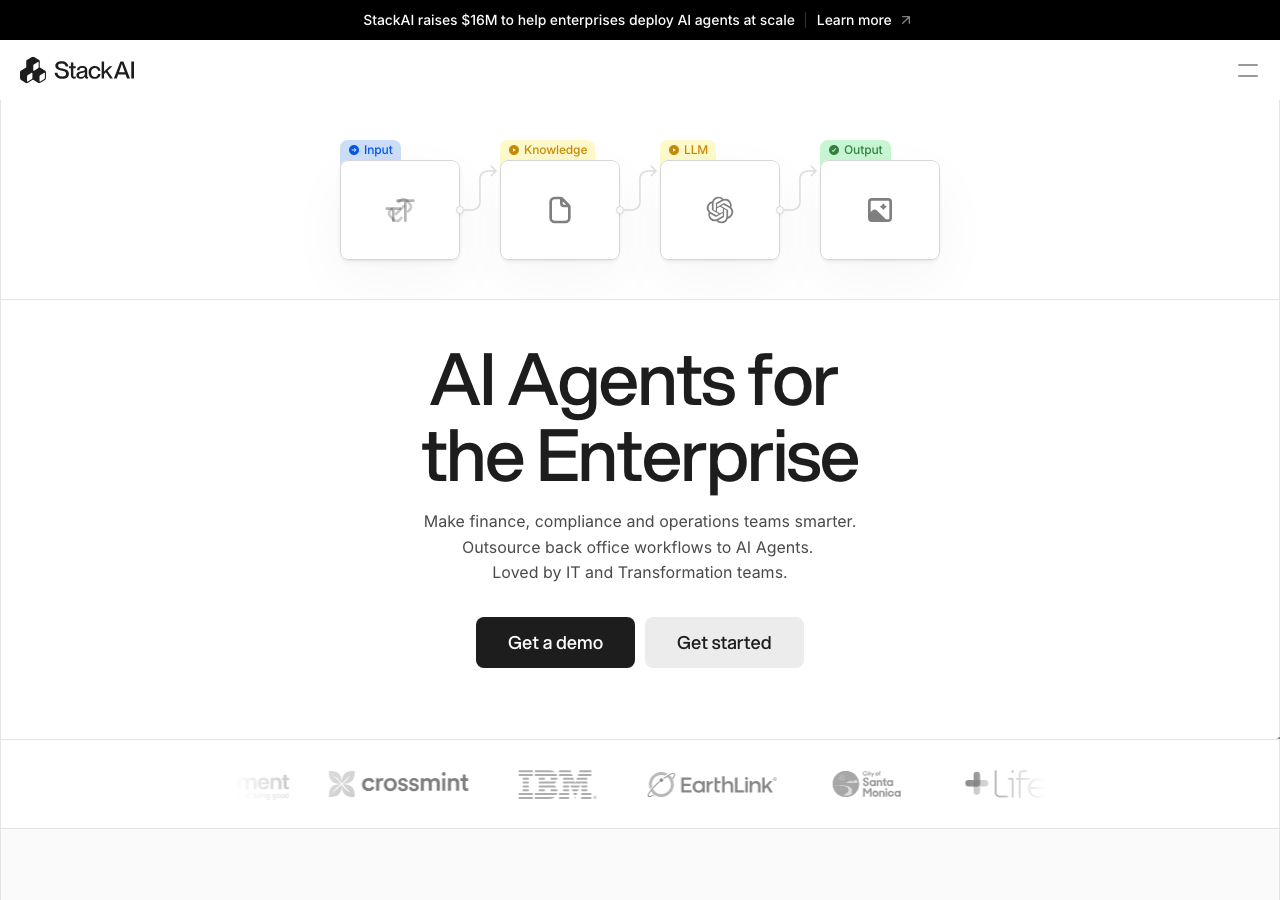
Empower enterprises to deploy AI Agents at scale
Based on user reviews
Rating Distribution
Morgan Reese
4 months ago
Evaluated Stack AI for three weeks as part of a workflow revamp in our mid-size SaaS company. The drag-and-drop builder is genuinely intuitive, and the 100+ connectors saved us a ton of integration time. I do wish setup for certain modules (like SharePoint) was clearer, and the documentation could be stronger. Free tier is generous, but pricing leaps fast for bigger teams. If you need enterprise automation without code, it's tough to beat.
Albert Schaper(Artificial Intelligence, AI Tools)
With a 4.0/5 rating from 1 user review, Stack AI receives positive evaluation from Albert Schaper for Conversational AI use cases. Albert Schaper's background in artificial intelligence highlights the tool's value for business executives needing artificial intelligence solutions.
Pricing: $0 – $899 / month(Updated November 2025)
Free tier with 500 runs/month, Starter at $199/month, Team at $899/month, Enterprise plan with custom pricing in USD
Usage Model: API Calls, Pay-as-You-Go — ensuring you only pay for what you actually use.
The free tier from Stack AI gives business executives a risk-free way to explore conversational ai capabilities. Free plans include essential features that enable basic workflows and experimentation. Upgrading unlocks premium tools, better performance, and professional features designed for business executives with complex conversational ai needs.
Stack AI is an enterprise-focused, no-code platform that enables organizations to build, deploy, and automate custom AI agents and workflows. The platform features a drag-and-drop interface to securely integrate with company data, extract insights from unstructured data, generate documents, and automate business operations—no coding or deep AI expertise required.
Understanding the core functionality and approach of Stack AI.
Stack AI meters activity so invoices mirror real adoption instead of seat assumptions. Experiments can scale without renegotiating budgets every quarter. Usage-based billing keeps costs aligned with real adoption.
Explore the powerful features that make Stack AI stand out.
Stack AI remembers previous conversations to provide consistent, context-aware responses. Currently optimized for Web App.
Rate limits and authentication are clearly documented for smooth implementation. Automation handles the repetitive work so teams can focus on strategy.
SDKs for Python and JavaScript/TypeScript remove boilerplate and shorten the path to production.
Trigger-based flows keep work moving without extra check-ins. Automation handles the repetitive work so teams can focus on strategy.
Decision-makers get real-time context without waiting on manual reporting. Analytics and reporting surface the metrics needed to act quickly.
Discover how different audiences leverage Stack AI for their specific needs.
Support teams deploy Stack AI to handle common questions, freeing agents for complex issues. Support leaders get knowledge, automation, and collaboration in one place.
With SDKs and webhooks, engineers connect Stack AI to deployments, CI/CD, and monitoring pipelines. Automation handles the repetitive work so teams can focus on strategy.
Stack AI aggregates insights across product, marketing, and support so releases stay aligned. Analytics and reporting surface the metrics needed to act quickly.
Discover more AI tools in related categories, platforms, and use cases.
Deepen your understanding of the concepts behind tools like Stack AI with our expert guides.
Understand core concepts like LLMs and Machine Learning.
Master search, filtering, and comparison to find the perfect tool.
Learn to craft effective prompts to command AI models.
Integrate AI into your daily workflows ethically and effectively.
See how Stack AI stacks up against similar alternatives in the market.

Build, automate, and scale with next-gen AI agents and data on the #1 Agentforce 360 Platform.

Build, deploy, and manage autonomous AI agents—automate anything, effortlessly.
Explore these popular alternatives to Stack AI for your specific needs.
Take your tool to the next level with Featured placements, Academy mentions with high-authority backlinks, 48h Fast‑Track listing, Newsletter features to thousands of AI practitioners, and exclusive Data/API access for growth insights.
Use this page as a starting point to evaluate Stack AI alongside similar options. Our directory focuses on practical details that matter for adoption—capabilities, pricing signals, integrations, and real audiences—so you can shortlist with confidence and move from exploration to evaluation faster.
For a structured head‑to‑head, try the comparison view: Compare AI tools. To stay current with launches, model updates, and research breakthroughs, visit AI News. New to the space? Sharpen your understanding with AI Fundamentals.
Before adopting any tool, model your total cost at expected usage, verify integration coverage and API quality, and review privacy, security, and compliance. A short pilot on a real workflow will reveal reliability and fit quickly. Bookmark this site to track updates to Stack AI and the broader ecosystem over time.
Found incorrect information or have concerns about Stack AI? Let us know.
Looking for alternatives to Stack AI or similar tools? Use our AI-powered chatbot to discover the perfect solution for your needs.
