
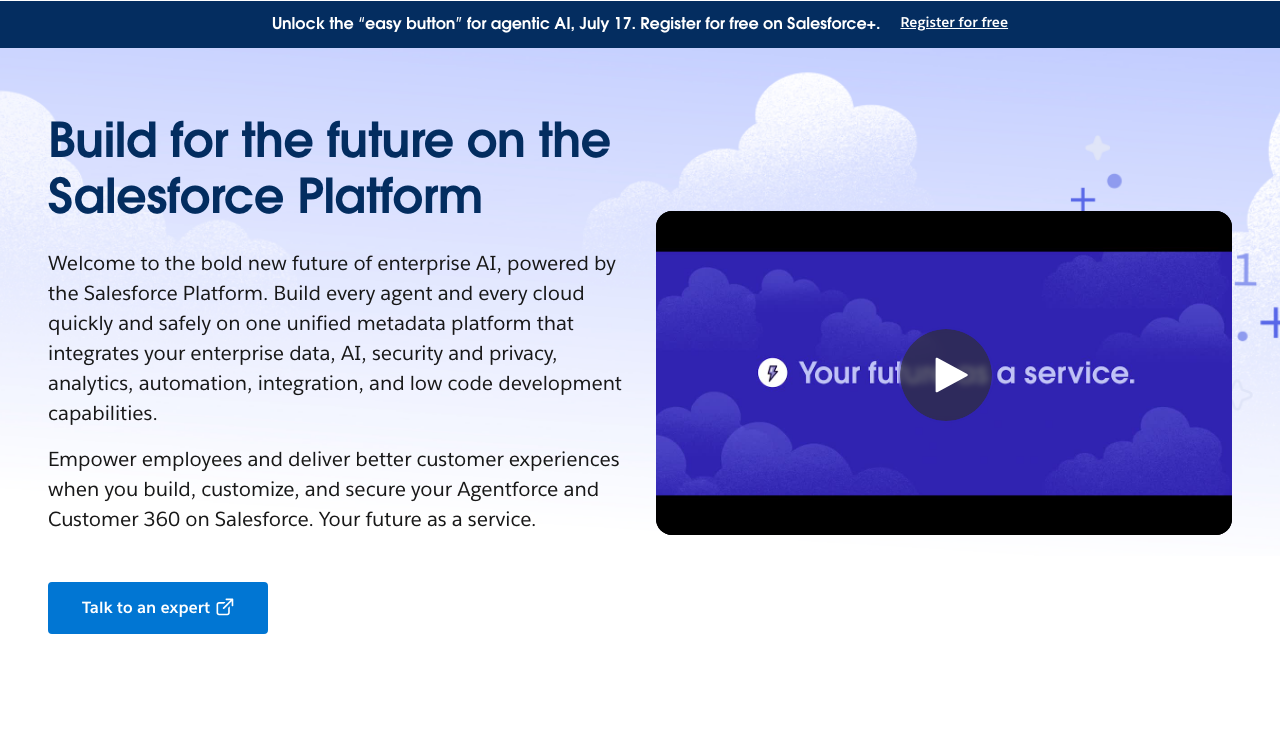


Salesforce Platform: A Deep Dive into Agentic Enterprise Automation
Introduction
Salesforce Platform's evolution into an Agentforce 360 Platform marks a significant shift in the CRM landscape. This transformation addresses the growing need for businesses to leverage AI, data, and automation to enhance customer experiences and streamline operations. The platform's comprehensive integration of Data 360, Agentforce, Customer 360, and Slack creates a unified environment for building and deploying AI-powered solutions. With a global rank of #171 and over 126 million monthly visits, the Salesforce Platform holds a significant position in the market. This analysis explores the strategic implications of this platform, its potential applications, and its competitive standing.
Strategic Analysis: Why Agentforce 360?
The emergence of Agentforce 360 highlights several key industry trends:
- The Rise of AI-Powered Automation:Businesses are increasingly seeking ways to automate complex tasks using AI, particularly generative AI and autonomous agents. This trend is driven by the need to improve efficiency, reduce costs, and enhance decision-making.
- The Importance of Data Unification:Siloed data hinders effective AI implementation. Platforms that can unify data from various sources, like Data 360, provide a significant advantage.
- The Demand for Low-Code/Pro-Code Flexibility:Organizations need tools that allow both business users and developers to contribute to the development process. The combination of low-code and pro-code capabilities enables faster innovation and greater customization.
- The Need for Seamless Collaboration:Real-time collaboration between humans and AI agents is crucial for effective automation. The integration of Slack within the Salesforce Platform addresses this need.
The Salesforce Platform's Agentforce 360 offering directly responds to these trends by providing a comprehensive solution for building and deploying AI-powered business applications. This strategic positioning aims to solidify Salesforce's leadership in the CRM market and capture a larger share of the growing AI automation market.
Real-World Applications and Use Cases
The Salesforce Platform can be applied in various industries and functional areas. Here are a few generic use case scenarios:
- Customer Service Automation:
- Problem:High volumes of customer inquiries, long wait times, and inconsistent service quality.
- Solution:Implement AI-powered chatbots and virtual agents using Agentforce to handle routine inquiries, provide personalized recommendations, and escalate complex issues to human agents. Leverage Data 360 to provide agents with a unified view of customer data, including past interactions, preferences, and purchase history.
- Expected Outcomes:Reduced wait times, improved customer satisfaction, lower support costs, and increased agent productivity. Industry benchmarks suggest that AI-powered customer service solutions can reduce support costs by up to 30% and improve customer satisfaction scores by 10-15%.
- Lessons Learned:Ensure the AI agents are well-trained on relevant data, provide clear escalation paths to human agents, and continuously monitor and optimize the performance of the AI agents.
- Sales Process Optimization:
- Problem:Inefficient sales processes, low conversion rates, and difficulty in identifying high-potential leads.
- Solution:Use AI-powered lead scoring and opportunity management to identify and prioritize the most promising leads. Automate routine tasks such as data entry, follow-up emails, and meeting scheduling. Leverage generative AI to create personalized sales pitches and proposals. Utilize workflow automation to streamline the sales process from lead generation to close.
- Expected Outcomes:Increased sales conversion rates, improved sales productivity, shorter sales cycles, and higher revenue. Sales teams using AI-powered tools typically see a 25-35% improvement in lead conversion rates.
- Lessons Learned:Integrate the AI tools with existing CRM systems, provide sales reps with adequate training on how to use the AI tools, and continuously monitor and optimize the performance of the AI tools.
- Marketing Campaign Management:
- Problem:Difficulty in personalizing marketing messages, low engagement rates, and inefficient campaign execution.
- Solution:Leverage Data 360 to create unified customer profiles and segment audiences based on demographics, behavior, and preferences. Use generative AI to create personalized marketing content, including email subject lines, ad copy, and landing pages. Automate the execution of marketing campaigns across multiple channels, such as email, social media, and web. Utilize AI-powered analytics to track campaign performance and optimize campaigns in real-time.
- Expected Outcomes:Higher engagement rates, improved conversion rates, increased customer lifetime value, and reduced marketing costs. Marketing teams using AI-powered tools often see a 20-30% improvement in campaign performance.
- Lessons Learned:Ensure the data used to train the AI models is accurate and up-to-date, provide clear guidelines for the use of AI in marketing campaigns, and continuously monitor and optimize the performance of the AI models.
Competitive Landscape and Market Trends
The Salesforce Platform faces competition from several players in the CRM and AI automation markets. Key competitors include:
- HubSpot:A leading CRM platform that offers a range of marketing, sales, and service tools. HubSpot is known for its user-friendly interface and strong focus on inbound marketing.
- n8n:An open-source workflow automation platform that allows users to connect different applications and automate tasks. n8n is a flexible and customizable platform that is popular among developers.
- AutoGPT:A platform for building and deploying autonomous AI agents. AutoGPT enables users to automate complex tasks that require reasoning and decision-making.
- Jotform AI Agents:A tool that allows users to turn conversations into completed forms and actions. Jotform AI Agents is a simple and easy-to-use tool that is ideal for automating data collection and processing.
- Azure [Machine [Learnin](/learn/machine-learning-basics)g](/learn):A cloud-based platform for building, training, and deploying machine learning models. Azure Machine Learning provides a comprehensive set of tools and services for data scientists and machine learning engineers.
The market for AI-powered CRM solutions is rapidly evolving. Key trends include:
- The increasing adoption of generative AI:Generative AI is being used to automate a wide range of tasks, such as content creation, lead generation, and customer service.
- The growing demand for autonomous agents:Autonomous agents are capable of performing complex tasks without human intervention, enabling businesses to automate entire workflows.
- The importance of data governance and security:As businesses collect and process more data, they need to ensure that their data is secure and compliant with relevant regulations.
The Salesforce Platform is well-positioned to capitalize on these trends. Its comprehensive suite of tools and services, combined with its strong focus on AI and automation, makes it a compelling choice for businesses looking to transform their operations.
Expert Perspectives: Strengths, Weaknesses, and ROI
Strengths:
- Comprehensive Platform:The Salesforce Platform offers a complete suite of tools and services for CRM, AI, and automation, providing a one-stop shop for businesses looking to transform their operations.
- AI-Powered Automation:The Agentforce 360 platform leverages AI to automate complex tasks, improve efficiency, and enhance decision-making.
- Data Unification:Data 360 unifies data from various sources, providing a single view of the customer and enabling personalized experiences.
- Low-Code/Pro-Code Flexibility:The platform allows both business users and developers to contribute to the development process, enabling faster innovation and greater customization.
- Strong Ecosystem:The Salesforce ecosystem provides a wide range of integrations, partners, and resources, making it easy for businesses to implement and customize the platform.
Weaknesses:
- Complexity:The Salesforce Platform can be complex to implement and manage, requiring specialized skills and expertise. This is noted in some user reviews, mentioning the learning curve.
- Cost:The Salesforce Platform can be expensive, particularly for small and medium-sized businesses.
- Integration Challenges:Integrating the Salesforce Platform with legacy systems can be challenging and time-consuming.
ROI Considerations:
The ROI of the Salesforce Platform depends on several factors, including the size and complexity of the organization, the specific use cases implemented, and the effectiveness of the implementation. However, organizations that successfully implement the Salesforce Platform can expect to see significant improvements in sales, marketing, and customer service. Some users report increased efficiency and better customer insights, which contribute to a positive ROI.
Based on industry benchmarks and user feedback, organizations can expect to see the following benefits:
- Increased sales conversion rates
- Improved sales productivity
- Shorter sales cycles
- Higher customer satisfaction scores
- Reduced support costs
- Improved marketing campaign performance
Actionable Guidance: Implementation and Optimization
Here are some actionable steps for implementing and optimizing the Salesforce Platform:
1. Define Clear Goals and Objectives: Before implementing the Salesforce Platform, it is important to define clear goals and objectives. What do you want to achieve with the platform? What metrics will you use to measure success?
2. Develop a Comprehensive Implementation Plan: A well-defined implementation plan is essential for a successful implementation. The plan should include a timeline, budget, and resource allocation. It should also identify key stakeholders and their responsibilities.
3. Choose the Right Implementation Partner: Implementing the Salesforce Platform can be complex, so it is important to choose the right implementation partner. Look for a partner with experience in your industry and a proven track record of success.
4. Provide Adequate Training: Ensure that your employees receive adequate training on how to use the Salesforce Platform. This will help them to be more productive and effective.
5. Monitor and Optimize Performance: Continuously monitor and optimize the performance of the Salesforce Platform. Track key metrics and make adjustments as needed. This will help you to maximize the ROI of the platform.
Conclusion
The Salesforce Platform's evolution into the Agentforce 360 Platform signifies a strategic response to the increasing demands for AI-powered automation, data unification, and low-code/pro-code flexibility. While the platform presents complexities in implementation and cost considerations, its comprehensive features and capabilities position it as a strong contender in the CRM and AI automation market. By carefully planning implementation, providing adequate training, and continuously monitoring performance, organizations can leverage the Salesforce Platform to achieve significant improvements in sales, marketing, and customer service, driving substantial ROI and solidifying their competitive edge.