AI 2041
Ten Visions for Our Future — A Critical Reading
TL;DR:
AI 2041 is one of the most influential attempts to make AI futures feel normal. It's technically grounded and often accurate — but it quietly assumes that more AI, more data, and more optimization are always the right answers. Read it as both a guide and a foil.

About the Book
Authors: Kai-Fu Lee (former president of Google China, CEO of Sinovation Ventures) & Chen Qiufan (award-winning science fiction author) • Published: 2021 • Length: ~480 pages
Central Innovation
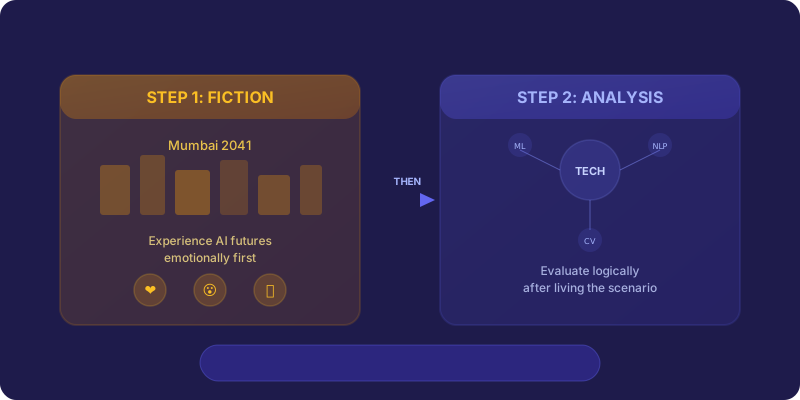
"Scientific Fiction" as a Persuasion Tool
Why the Format Matters
Lowers Skepticism
You experience AI futures emotionally before you evaluate them logically. By the time you get to the analysis, you've already "lived" the scenario through the characters.
Naturalizes Outcomes
When a scenario is wrapped in a personal story — a kid with a learning tutor, an elderly parent with AI care — it starts to feel less like a choice and more like an inevitable trajectory of "progress".
Frames Trade-offs as Design Details
Most core tensions — labor displacement, data governance, nudging, algorithmic power — appear as things to be tuned and optimized, not contested.
For Your Academy
Where the Book Is Surprisingly Accurate
By early 2026, a non-trivial chunk of AI 2041 no longer reads like sci-fi at all. Independent fact-checks point out how many of its "2041" scenarios are here in prototype form.
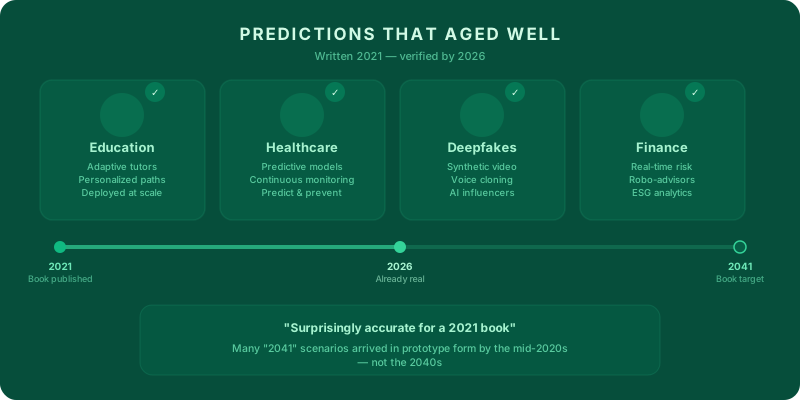
🎓AI in Education
Intelligent tutors, adaptive learning, and personalized study paths are no longer speculative — they are being deployed at scale in both consumer apps and institutional pilots.
🏥Predictive Healthcare
Models that anticipate disease risk and monitor patients continuously are moving into mainstream healthcare infrastructure, shifting from "diagnose and treat" toward "predict and prevent".
🎭Deepfakes & Synthetic Media
The explosion of believable synthetic video, voice cloning, and AI-generated influencers arrived earlier than many policymakers were ready for.
💰Financial Decision Intelligence
"Robo-advisors on steroids", real-time risk modeling, and AI-augmented treasury and ESG analytics are becoming standard in financial infrastructure.
Why This Matters
The Blind Spot: "Neutral" Technology and Solutionism
The most important critique — and the one learners almost never see in mainstream summaries — is about the ideology baked into the stories. Virginia L. Conn's review in the Los Angeles Review of Books calls out what she terms the "tyranny of neutrality".
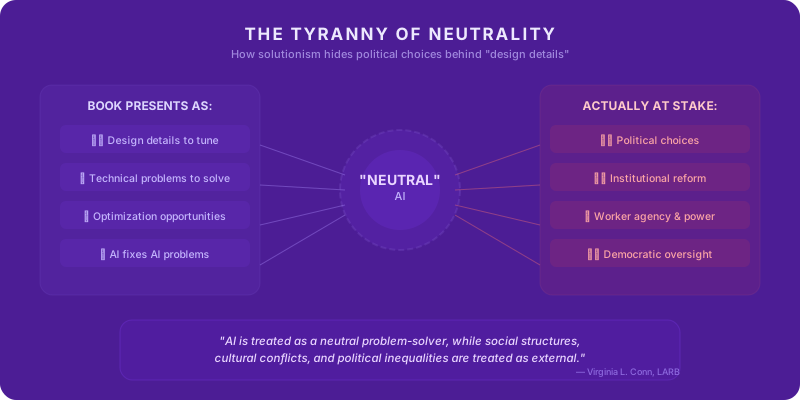
AI as Neutral Problem-Solver
The book repeatedly presents AI as a neutral problem-solver, while social structures, cultural conflicts, and political inequalities are treated as "external" issues that AI simply reacts to or optimizes.
Example — "Twin Sparrows": The solution to a child's autism is not community adaptation, inclusive schools, or changing expectations — it is an AI companion that better understands him, leaving underlying social norms unchanged.
The Solutionist Worldview
AI 2041 quietly advances a worldview where more data and better algorithms are the default answer to human and societal complexity. That framing:
- De-politicizes issues like education, care work, and social safety nets by recasting them as arenas for optimization, not contestation.
- Normalizes continuous data collection as the baseline needed for "better outcomes".
- Suggests that ethical questions will largely be solved by more sophisticated AI research and design — echoing Lee's argument that many AI-caused problems will ultimately be solved by AI itself.
The Value for Learners
Jobs, Inequality, and What the Stories Don't Force You to Confront
Lee's earlier work, AI Superpowers, puts a heavy focus on jobs, inequality, and geopolitical competition. AI 2041 softens that through fiction — but the underlying assumptions are still there.
What the Book Gets Right
Distinguishes between jobs AI will take (routine, repetitive, data-driven) and those it won't (creative, strategic, high-touch roles).
Calls for retraining and elevating human-centric work in care, creativity, and complex social contexts.
What the Stories Avoid
The stories rarely linger on the messy transition: who funds retraining, what happens in regions without safety nets, how power imbalances between AI-rich platforms and workers get managed.
Lee often defaults to the argument that "AI researchers will solve AI-caused problems" — bias fixed by better models, privacy by better tech, deepfakes by better detection.
What's Missing from the "AI Fixes AI" Logic
- 1.Institutional reform, redistribution, and regulation beyond technical fixes.
- 2.Worker agency and resistance, not just adaptation.
- 3.Democratic oversight over where and how AI is deployed in the first place.
What Aged Badly: Timelines and the "Non-AGI" Comfort
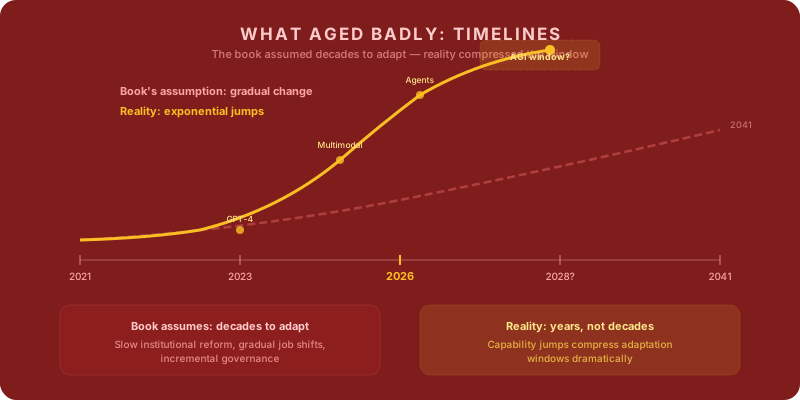
One of the more interesting 2026 critiques is that AI 2041's most dated element may be its comforting distance from AGI. Lee expressed skepticism about near-term artificial general intelligence, arguing more for powerful narrow systems and incremental disruption.
The Book's Assumption
We have decades to slowly adapt
Systems, jobs, and governance will gradually adjust to a more powerful version of 2021-style AI. Institutions have time to catch up.
Reality by 2026
Years, not decades
Capability jumps (especially in multimodal models and agents) are compressing adaptation windows.
Many "2041" scenarios arrived in early form in the mid-2020s.
Some industry experts place plausible AGI windows between 2026 and 2028.
Implication for Your Learning
How to Actually Use AI 2041 as a Debate Partner
Instead of listing it as "another future-of-AI book", position AI 2041 as a structured debate partner inside your learning:
In Ethics & Fundamentals
Assign one or two stories plus Lee's analysis. Pair them with critical reviews (e.g., LARB's "tyranny of neutrality").
Discussion Prompts:
- • Where is AI treated as neutral?
- • What alternatives to "more AI" are missing?
- • Who has power in this scenario, and who doesn't?
In Role-Based Learning
Map each story's domain (education, insurance, smart cities) to current tools and deployments.
Exercises:
- • Identify which parts are already real and which remain fiction
- • Design "counter-scenarios" that prioritize equity, worker agency, or public governance
- • Compare the book's vision with tools in our AI tool directory
In AI Readiness & Strategy
Use AI 2041 to illustrate stages of readiness: from "curious" to "leading". But explicitly add a dimension missing in the book: organizational and societal responsibility — not just technical capability.
See our AI Readiness Framework for a structured assessment.
Key Takeaways
What the Book Does Well
- • Technically grounded near-term AI forecasting
- • Many predictions already verified by 2026
- • Accessible format that makes AI futures tangible
- • Covers diverse global settings (Mumbai, Lagos, Shanghai)
- • Useful baseline for mapping current tools to future trajectories
What to Read Critically
- • Treats AI as neutral — hides political choices
- • Solutionist framing: more data = better outcomes
- • Avoids the messy transition (who pays, who loses)
- • "AI fixes AI" logic underplays institutional reform
- • Timeline assumptions are already too conservative
Apply It: Read AI Narratives Critically
- 1Pick one AI tool you use daily. Write a short "2041 story" about how it might evolve. What assumptions are you making about who benefits?
- 2Identify one area where you unconsciously treat AI as "neutral". What political or social choice is hidden behind that assumption? Discuss with Claude
- 3For one AI prediction you've heard recently, ask: Who wins? Who loses? What alternatives are silently taken off the table?
- 4Design a "counter-scenario" for one of AI 2041's stories: same technology, but prioritizing equity, worker agency, or public governance instead of commercial optimization.
Tools to Evaluate Critically
Apply the book's lens to real AI tools
Key Insights: What You've Learned
AI 2041's "scientific fiction" format is a powerful persuasion architecture: stories lower skepticism, naturalize certain outcomes, and frame political choices as design details — understanding this mechanism is the first step to reading AI narratives critically.
The book's near-term predictions are surprisingly accurate (education, healthcare, deepfakes, finance are already here in prototype), but its timeline assumptions are too conservative — capability jumps are compressing adaptation windows from decades to years.
The most important lesson is what the book hides: a solutionist worldview where more AI, more data, and more optimization are always the answer — your job is to ask who wins, who loses, and what alternatives are silently taken off the table.
Copyright & Legal Notice
© 2026 Best AI Tools. All rights reserved.
All content on this page has been created and authored by Best AI Tools. This content represents original works and summaries produced by our editorial team.
The materials presented here are educational in nature and are intended to provide accurate, helpful information about artificial intelligence concepts. While we strive for accuracy, this content is provided "as is" for educational purposes only.
Test Your Knowledge
Complete this quiz to test your understanding of AI 2041's key arguments, blind spots, and critical reading techniques.
Loading quiz...