Multi-Agent AI: Unleashing Collective Intelligence for Smarter Solutions
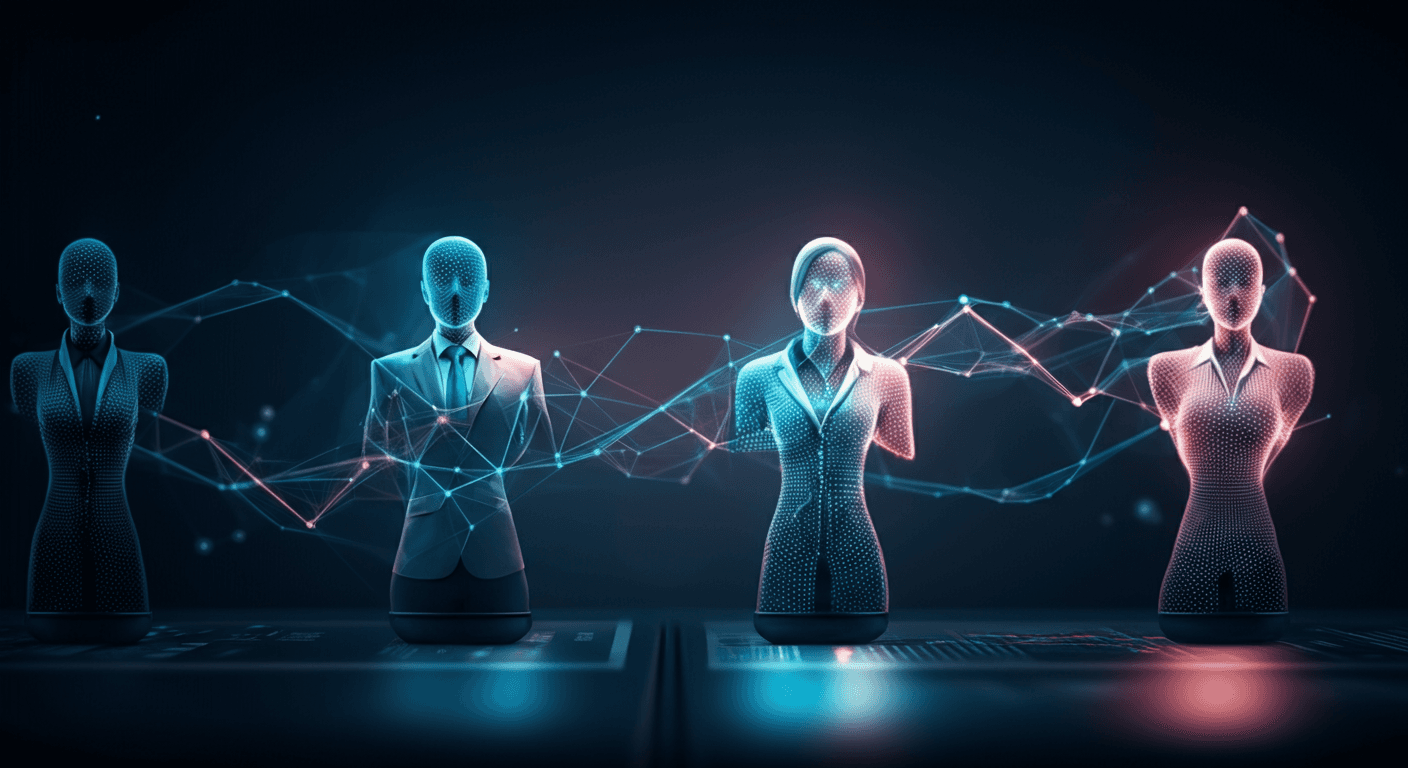
Unleash the collective power of AI to solve problems previously deemed insurmountable with single-agent systems.
Understanding Multi-Agent AI Systems
Multi-agent systems (MAS) are comprised of multiple intelligent agents that interact within a shared environment. These agents communicate, coordinate, and compete to achieve individual or collective goals. ChatGPT is an example of an AI that could potentially operate within a multi-agent system, depending on how it's designed.
Advantages Over Single-Agent Systems
Multi-agent systems offer several key advantages:
- Distributed problem-solving: Complex tasks are broken down and solved collaboratively.
- Scalability: Adding more agents increases capacity.
- Robustness: System can tolerate individual agent failures.
- Complex task handling: MAS can manage problems too large for single agents.
Real-World Applications
The versatility of multi-agent AI leads to diverse applications. Consider these examples:
- Robotics: Coordinated robots performing assembly tasks.
- Supply Chain Management: Optimizing logistics through agent collaboration.
- Traffic Control: Adaptive traffic light systems.
- Smart Grids: Distributed energy management.
- AI Art: Collaborative art generation by multiple AI artists.
Challenges in MAS Design

Designing efficient multi-agent AI systems isn't without challenges:
- Coordination: Ensuring agents work together effectively.
- Communication: Establishing clear communication protocols.
- Conflict Resolution: Managing conflicting goals.
- Emergent Behavior: Predicting and controlling unexpected outcomes.
- Agent Autonomy: The level of independence an agent has.
- Heterogeneity: Dealing with agents that have diverse capabilities.
- Cooperation: Agents working together towards a shared objective.
- Competition: Agents vying for limited resources.
- Negotiation: Agents reaching agreements.
Unleash the power of collective intelligence with Multi-Agent AI, where multiple AI agents collaborate to solve complex problems more effectively than single AI systems.
Architectures for Multi-Agent Systems
Common multi-agent system architectures include:- Blackboard Systems: Agents read/write to a shared "blackboard" data structure.
- Contract Net Protocol: Agents bid on tasks, enabling efficient task allocation.
- Agent-Oriented Programming: Design revolves around autonomous agents interacting within an environment.
Frameworks and Platforms
- JADE (Java Agent Development Framework): A popular framework for building agent-based systems. Check out a JADE framework tutorial to get started.
- Other frameworks include platforms like AnyLogic for simulation and robotics platforms with multi-agent capabilities.
Communication and Knowledge
- FIPA ACL: The FIPA ACL language defines standards for agent communication.
- KQML: Another agent communication language.
- Ontologies: Structured vocabularies that help agents share and understand knowledge. Ontologies ensure consistent knowledge representation in multi-agent AI.
Security Considerations
Security is paramount. Implement robust authentication, authorization, and encryption to protect agents and data. Multi-Agent Systems for Cyber Defense is discussed in this AI News article.Multi-Agent AI offers a promising path toward smarter, more adaptable solutions. Explore our Software Developer Tools to find the right tools to implement Multi-Agent Systems for your needs.
Unleashing collective intelligence, multi-agent AI promises smarter solutions to complex problems.
Coordination Mechanisms
Multi-agent systems require effective coordination. Centralized coordination relies on a single agent managing tasks. Decentralized coordination distributes control amongst agents, increasing robustness. For instance, a smart city uses decentralized AI for traffic management. This prevents a single point of failure. ChatGPT can help in designing the algorithms for these complex systems.Communication Strategies
Communication is vital for multi-agent success. Direct communication allows agents to exchange information explicitly. Indirect communication, called stigmergy, uses the environment as a shared medium. > Ants using pheromone trails to find food is a classic example of stigmergy in multi-agent systems.Negotiation Strategies
Negotiation allows agents to resolve conflicts. Game theory provides a framework for analyzing strategic interactions. Auction mechanisms and argumentation can also be used for reaching agreements. These strategies are essential for optimizing resource allocation in a distributed manner.Communication Challenges
Communication isn't always perfect. Noisy or unreliable environments can disrupt communication. This can create challenges for robust multi-agent communication. Techniques for learning communication protocols AI can help agents adapt to these conditions, improving overall system performance.Exploring multi-agent systems unveils exciting possibilities for AI's future. Learn more about similar innovations in our Learn AI section.
Unlocking the potential of multi-agent AI requires understanding the algorithms that power their collective intelligence.
AI Algorithms Powering Multi-Agent Intelligence
Reinforcement Learning
Multi-agent systems (MAS) commonly use reinforcement learning. In cooperative multi-agent reinforcement learning (MARL), agents learn to collaborate to achieve a common goal. Competitive MARL involves agents competing against each other. For instance, consider a smart grid where multiple agents (representing individual households or power plants) use multi-agent reinforcement learning to optimize energy distribution.Evolutionary Algorithms
These algorithms optimize agent design. By mimicking natural selection, they iteratively improve agent strategies. For example, in robotics, evolutionary algorithms for AI agents can design controllers for swarms of robots performing search and rescue operations.Swarm Intelligence
Ant colony optimization and particle swarm optimization are swarm intelligence algorithms.
- Ant colony optimization finds optimal paths.
- Particle swarm optimization finds the best solutions by mimicking the behavior of bird flocks or fish schools.
Deep Learning
Deep learning enables deep reinforcement learning multi-agent systems. These systems can handle complex, high-dimensional environments. Deep learning is used for emergent behavior in multi-agent systems. For example, self-driving cars can coordinate movements.Emergent Behavior
AI can foster emergent behavior. Simple agent rules can lead to complex, coordinated actions at the system level. Consider the classic example of flocking simulations, where each agent (bird) follows simple rules regarding its neighbors, yet the flock as a whole exhibits complex, coordinated movement.Multi-agent systems are using AI to create smarter solutions. Explore our AI Tool Directory to discover more.
Harnessing the collective intelligence of multiple AI agents is no longer a futuristic fantasy, but a tangible reality.
Tools and Platforms for Multi-Agent AI Development
Multi-agent AI systems are transforming various industries. They offer solutions far exceeding single-agent capabilities. Several tools and platforms facilitate the development of these complex systems.
Simulation Environments
These environments enable testing and refining multi-agent interactions.
- NetLogo: NetLogo is a programmable modeling environment. It's used to simulate natural and social phenomena. It's particularly well-suited for modeling complex systems evolving over time.
- Repast Simphony: A free and open-source agent-based modeling toolkit.
- MASON: Another Java-based multi-agent simulation framework. MASON excels in creating large-scale agent simulations.
Agent Development Platforms
These platforms provide the necessary tools to construct individual agents and orchestrate their interactions.
- SPADE: SPADE simplifies building multi-agent systems with Python. It adheres to the FIPA standards for agent communication.
- AnyLogic: AnyLogic supports various modeling methods, including agent-based, discrete event, and system dynamics. This platform is used to simulate complex systems.
Cloud-Based Platforms
These provide the scalability required for deploying large multi-agent systems.Cloud platforms offer the infrastructure needed for resource-intensive MAS, enabling developers to focus on the logic and interactions of their agents.
Integration with Other AI Technologies
Combining multi-agent systems with other AI domains creates synergistic effects. Think integrating computer vision for robotic agents, or NLP to improve communication.Testing and Debugging
Testing multi-agent systems poses unique challenges. The emergent behavior of agents requires thorough validation. Standard debugging tools often fall short due to the distributed and asynchronous nature of these systems.Multi-agent AI offers immense potential for innovation. Explore our Software Developer Tools to find solutions for your needs.
Multi-Agent AI: Unleashing Collective Intelligence for Smarter Solutions
Real-World Case Studies: Multi-Agent AI in Action
Can multiple AI minds be better than one? Multi-Agent Systems (MAS) are demonstrating incredible potential. These systems use multiple intelligent agents to solve problems collaboratively. Let's explore some compelling applications.
MAS in Robotics
Swarm robotics, a prime example, leverages Multi-Agent AI for collective tasks. Imagine tiny robots coordinating to clean up oil spills or search for survivors in collapsed buildings. Collaborative robots in factories also benefit, improving efficiency and safety.Supply Chain Optimization
"Multi-agent systems revolutionize supply chain management, optimizing logistics and inventory in ways previously impossible."
- Optimized delivery routes
- Reduced storage costs
- Improved responsiveness to demand changes
Traffic Management
Multi-agent traffic control systems can significantly reduce congestion. These systems coordinate traffic lights and manage vehicle flow dynamically. This results in smoother commutes and lower emissions. For example, algorithms can adapt signal timings based on real-time traffic data.Smart Grids
Balancing energy supply and demand is critical for efficient power distribution. Multi-Agent AI plays a role, optimizing energy flow and preventing blackouts. Smart grids also facilitate the integration of renewable energy sources.Ethical Considerations
The increasing use of MAS raises ethical questions. Ensuring fairness, transparency, and accountability becomes paramount. We must consider the potential impact on employment and decision-making processes. Are we ready for the ethics of multi-agent AI?From swarms of robots to smart grids, multi-agent AI is poised to reshape numerous industries. Explore our AI Tools to discover solutions for your business needs.
Multi-agent systems (MAS) are rapidly evolving, promising intelligent solutions for complex problems. Are you ready to explore the collective intelligence revolution?
The Future of Multi-Agent AI: Trends and Opportunities

Several exciting trends are shaping the future of multi-agent AI:
- Explainable AI (XAI) for MAS: Ensuring transparency. This is crucial for building trust, especially in critical applications. _Example:_ TracerootAI helps make AI decision-making more understandable.
- Human-Agent Collaboration: Integrating human expertise. This combines the strengths of both humans and AI. _Example:_ Imagine doctors using AI-powered medical transcription tools in conjunction with MAS to manage patient care more efficiently.
- Scaling Multi-Agent Systems: Handling complex environments. Addressing the challenge of managing large datasets and intricate interactions is key.
Applications in New Domains
MAS are finding applications in diverse fields:
- Personalized Healthcare: Tailoring treatment plans. MAS can analyze patient data and coordinate care.
- Financial Modeling: Simulating market behavior. Helping to predict trends and manage risk.
Challenges and Societal Impact
However, scaling MAS presents challenges:
- Managing large datasets and complex interactions.
- Addressing ethical considerations regarding autonomy and control.
The future of multi-agent AI is bright, with exciting advancements on the horizon. However, responsible development and careful consideration of societal impacts are essential.
Frequently Asked Questions
What is multi-agent AI?
Multi-agent AI refers to a system consisting of multiple intelligent agents that interact with each other within a shared environment. These agents communicate, coordinate, and sometimes compete to achieve individual or collective goals, working together to solve problems.What are the advantages of using multi-agent AI systems?
Multi-agent systems offer several benefits including distributed problem-solving, scalability, and robustness. They can handle complex tasks too large for single agents and are more resilient to individual agent failures.How can multi-agent AI be used in real-world applications?
Multi-agent AI has diverse applications, such as coordinating robots for assembly, optimizing supply chain logistics, managing traffic flow in smart cities, and distributing energy in smart grids. These systems enable more efficient and adaptive solutions than single-agent systems.What are some challenges in designing multi-agent AI systems?
Designing effective multi-agent AI systems involves complexities in coordination, communication, and ensuring agents act in alignment with overall system goals. Balancing individual agent autonomy with the need for collective intelligence is a key challenge.Keywords
multi-agent AI, multi-agent systems, AI agents, agent collaboration, collective intelligence, MARL, agent communication, swarm robotics, agent-based modeling, AI coordination, distributed AI, AI negotiation, JADE framework, NetLogo, agent autonomy
Hashtags
#MultiAgentAI #AICollaboration #CollectiveIntelligence #ArtificialIntelligence #AgentBasedModeling
Recommended AI tools

Google Gemini
Conversational AI
Your everyday Google AI assistant for creativity, research, and productivity

ChatGPT
Conversational AI
AI research, productivity, and conversation—smarter thinking, deeper insights.

Perplexity
Search & Discovery
Clear answers from reliable sources, powered by AI.

Sora
Video Generation
Create stunning, realistic videos & audio from text, images, or video—remix and collaborate with Sora 2, OpenAI’s advanced generative app.

Cursor
Code Assistance
The AI code editor that understands your entire codebase

DeepSeek
Conversational AI
Efficient open-weight AI models for advanced reasoning and research
About the Author

Written by
Regina Lee
Regina Lee is a business economics expert and passionate AI enthusiast who bridges the gap between cutting-edge AI technology and practical business applications. With a background in economics and strategic consulting, she analyzes how AI tools transform industries, drive efficiency, and create competitive advantages. At Best AI Tools, Regina delivers in-depth analyses of AI's economic impact, ROI considerations, and strategic implementation insights for business leaders and decision-makers.
More from ReginaWas this article helpful?
Found outdated info or have suggestions? Let us know!