
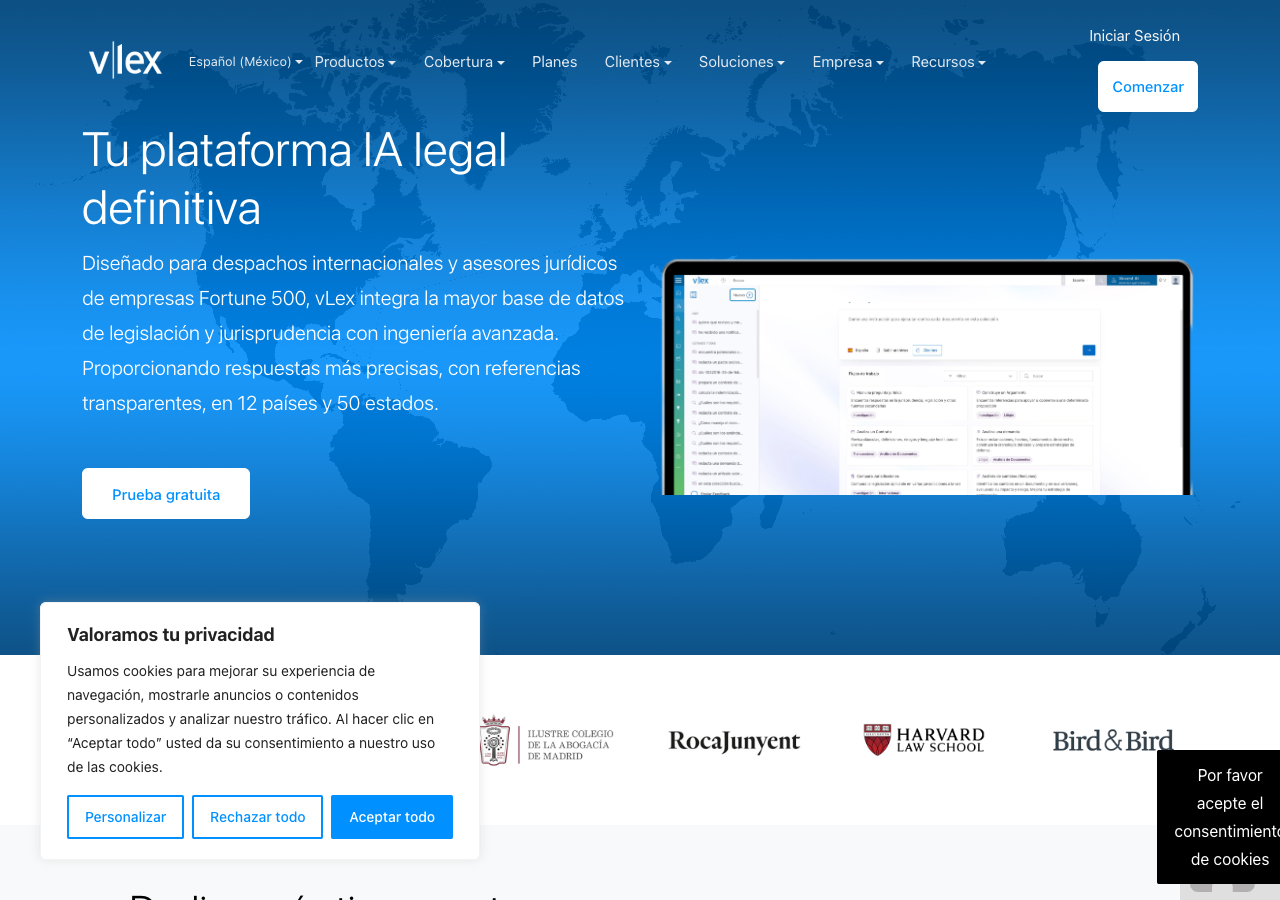
AI-powered global legal intelligence for lawyers and law firms
Based on user reviews
Rating Distribution
Daniela Romero
3 months ago
Trying out vLex for my thesis research in comparative law was eye-opening. The global reach is legit-accessing case law and statutes from tons of countries in one place saved me hours compared to fishing around in free databases. The Vincent AI actually understood legal questions and brought up super relevant cases even across languages, which felt light years ahead of old-school search tools. The new multimodal stuff is cool too; it analyzed a courtroom video and pulled out transcript snippets with citations. Still, the price tag is tough. Even with a student discount from my bar association, it's expensive. If you're not doing high-level research or don’t need obscure jurisdictions, the cost isn’t easy to justify. But if you need deep, cross-border legal research, vLex is seriously ahead of the curve.
Albert Schaper(Artificial Intelligence, AI Tools)
With a 4.0/5 rating from 1 user review, vLex receives positive evaluation from Albert Schaper for Conversational AI use cases. Albert Schaper's background in artificial intelligence highlights the tool's value for students needing artificial intelligence solutions.
Pricing: $320 – $399 / month(Updated November 2025)
Subscription plans start at approximately $320/month for one user. Some sources mention $399/month as starting price. Volume discounts for larger teams and custom enterprise pricing are available. No free plan for core content; limited access may exist via bar associations.
Usage Model: Pay-as-You-Go — ensuring you only pay for what you actually use.
Subscription-based access to vLex begins at $320 – $399 / month, delivering professional conversational ai capabilities for students. The monthly model ensures you're always using the latest version with current features. For students who need reliable conversational ai tools, subscriptions provide the best combination of functionality, support, and value.
vLex is a leading global legal intelligence platform offering access to more than one billion legal documents from over 100 jurisdictions. It integrates advanced AI-powered workflows such as Vincent AI, enabling legal professionals to efficiently research statutes, case law, regulations, dockets, and secondary sources. Key features include multimodal capabilities for analyzing audio and video legal materials, custom workflow creation, integration with productivity tools, and robust data governance, serving law firms, corporations, academics, and governments worldwide.
Understanding the core functionality and approach of vLex.
vLex charges based on real activity, making it ideal for variable workloads. Budget planning becomes simpler when costs directly reflect output volume. Usage-based billing keeps costs aligned with real adoption.
Explore the powerful features that make vLex stand out.
vLex remembers previous conversations to provide consistent, context-aware responses. Available across Web App, Mobile App, and API for consistent adoption.
Web, desktop, and beyond: vLex supports 3 platforms to streamline rollouts. Available across Web App, Mobile App, and API for consistent adoption.
Rate limits and authentication are clearly documented for smooth implementation. Automation handles the repetitive work so teams can focus on strategy.
Type-safe SDKs provide autocomplete and compile-time checks for faster development.
Trigger-based flows keep work moving without extra check-ins. Automation handles the repetitive work so teams can focus on strategy.
Discover how different audiences leverage vLex for their specific needs.
Bots, rules, and triggers ensure nothing gets stuck in manual queues. Integrations with API keep work connected.
Analysts use vLex to assemble data, explore patterns, and publish findings faster. Analytics and reporting surface the metrics needed to act quickly.
Discover more AI tools in related categories, platforms, and use cases.
Deepen your understanding of the concepts behind tools like vLex with our expert guides.
Understand core concepts like LLMs and Machine Learning.
Master search, filtering, and comparison to find the perfect tool.
Learn to craft effective prompts to command AI models.
Integrate AI into your daily workflows ethically and effectively.
See how vLex stacks up against similar alternatives in the market.
Explore these popular alternatives to vLex for your specific needs.
Take your tool to the next level with Featured placements, Academy mentions with high-authority backlinks, 48h Fast‑Track listing, Newsletter features to thousands of AI practitioners, and exclusive Data/API access for growth insights.
Use this page as a starting point to evaluate vLex alongside similar options. Our directory focuses on practical details that matter for adoption—capabilities, pricing signals, integrations, and real audiences—so you can shortlist with confidence and move from exploration to evaluation faster.
For a structured head‑to‑head, try the comparison view: Compare AI tools. To stay current with launches, model updates, and research breakthroughs, visit AI News. New to the space? Sharpen your understanding with AI Fundamentals.
Before adopting any tool, model your total cost at expected usage, verify integration coverage and API quality, and review privacy, security, and compliance. A short pilot on a real workflow will reveal reliability and fit quickly. Bookmark this site to track updates to vLex and the broader ecosystem over time.
Found incorrect information or have concerns about vLex? Let us know.
Looking for alternatives to vLex or similar tools? Use our AI-powered chatbot to discover the perfect solution for your needs.


