Empowering AI for All
Be the first to rate this tool!
No reviews yet
Be the first to review this tool!
Rating Distribution
No reviews yet. Be the first to share your experience!
Dr. William Bobos
Dr. William Bobos, specializing in AI tools, has reviewed Toolgo for Conversational AI. The tool shows particular promise for ai enthusiasts who work with AI tools tools regularly.
Pricing: $0 – $8 / month(Updated January 2026)
Free tier with 600 Standard queries/month and 30 Advanced queries/month, Pro $4/month (6,000 Standard and 300 Advanced queries/month), Ultimate $8/month (Unlimited queries)
Usage Model: API Calls, Pay-as-You-Go — ensuring you only pay for what you actually use.
Toolgo offers a free tier designed for ai enthusiasts who want to explore conversational ai without upfront investment. Free users can access core features and get familiar with the platform's capabilities. The paid tiers expand functionality significantly, offering professional-grade conversational ai tools for ai enthusiasts with more sophisticated needs.
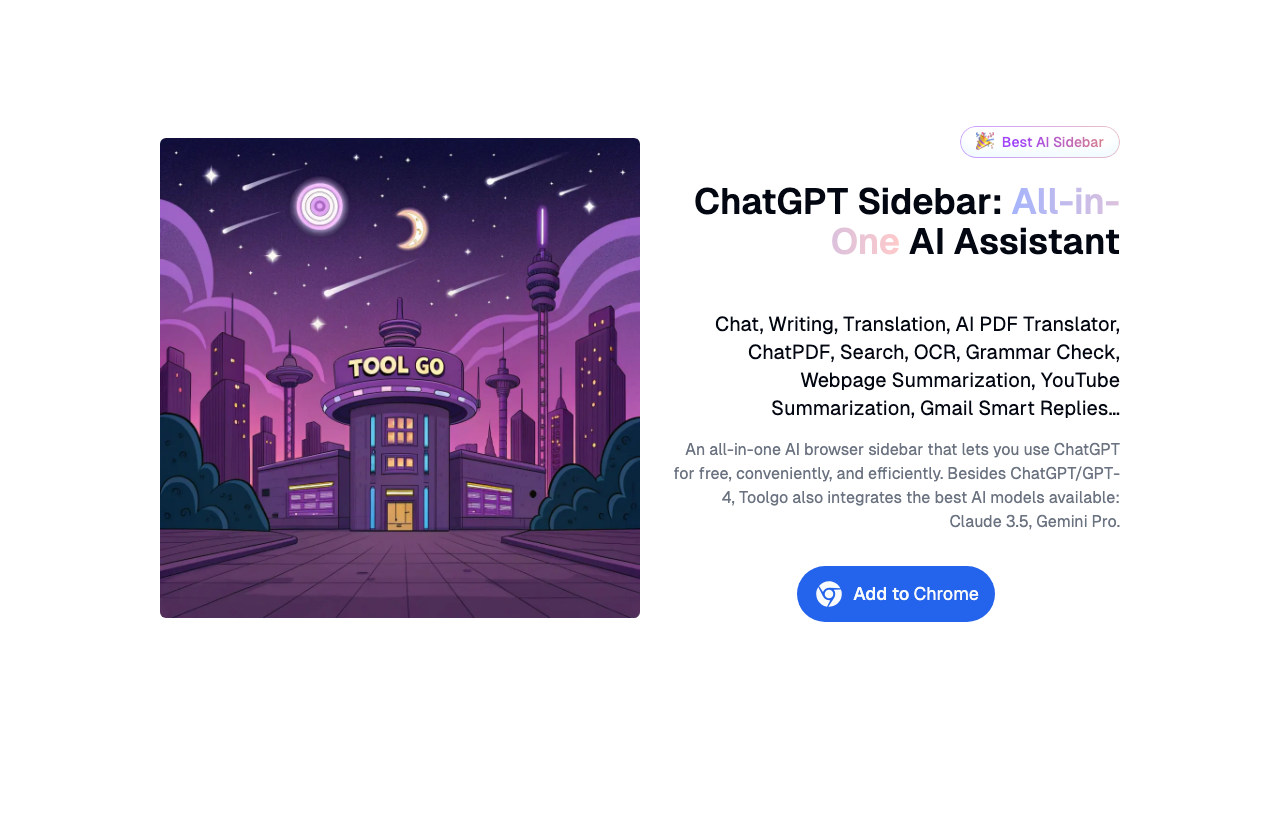
Toolgo is an AI-powered browser sidebar and web-based toolbox that enhances productivity with features like chat, writing assistance, PDF summarization, intelligent email replies, and more. It is designed to be user-friendly and accessible via browser integration.
Understanding the core functionality and approach of Toolgo.
Toolgo helps content creators generate ideas, refine messaging, and engage audiences. Chat-based interfaces make AI assistance feel natural and accessible. Latest release shipped on January 15, 2026, showing a fast-moving roadmap.
Explore the powerful features that make Toolgo stand out.
Multi-turn conversations feel natural, like talking to a knowledgeable colleague. Currently optimized for Web App.
Translate content between dozens of languages while preserving tone and nuance. Currently optimized for Web App.
Developers get client libraries that smooth integration work.
Trigger-based flows keep work moving without extra check-ins. Automation handles the repetitive work so teams can focus on strategy.
Toolgo consolidates data to expose actionable insights quickly. Analytics and reporting surface the metrics needed to act quickly.
Discover how different audiences leverage Toolgo for their specific needs.
Teams use Toolgo to translate product documentation, marketing materials, and support content.
Automate repetitive creative tasks so teams focus on high-impact work.
Bots, rules, and triggers ensure nothing gets stuck in manual queues. Automation handles the repetitive work so teams can focus on strategy.
Discover more AI tools in related categories, platforms, and use cases.
Deepen your understanding of the concepts behind tools like Toolgo with our expert guides.
Understand core concepts like LLMs and Machine Learning.
Master search, filtering, and comparison to find the perfect tool.
Learn to craft effective prompts to command AI models.
Integrate AI into your daily workflows ethically and effectively.
See how Toolgo stacks up against similar alternatives in the market.

AI research, productivity, and conversation—smarter thinking, deeper insights.

Your trusted AI collaborator for coding, research, productivity, and enterprise challenges
Explore these popular alternatives to Toolgo for your specific needs.
Take your tool to the next level with Featured placements, Academy mentions with high-authority backlinks, 48h Fast‑Track listing, Newsletter features to thousands of AI practitioners, and exclusive Data/API access for growth insights.
Use this page as a starting point to evaluate Toolgo alongside similar options. Our directory focuses on practical details that matter for adoption—capabilities, pricing signals, integrations, and real audiences—so you can shortlist with confidence and move from exploration to evaluation faster.
For a structured head‑to‑head, try the comparison view: Compare AI tools. To stay current with launches, model updates, and research breakthroughs, visit AI News. New to the space? Sharpen your understanding with AI Fundamentals.
Before adopting any tool, model your total cost at expected usage, verify integration coverage and API quality, and review privacy, security, and compliance. A short pilot on a real workflow will reveal reliability and fit quickly. Bookmark this site to track updates to Toolgo and the broader ecosystem over time.
Found incorrect information or have concerns about Toolgo? Let us know.
Looking for alternatives to Toolgo or similar tools? Use our AI-powered chatbot to discover the perfect solution for your needs.

