
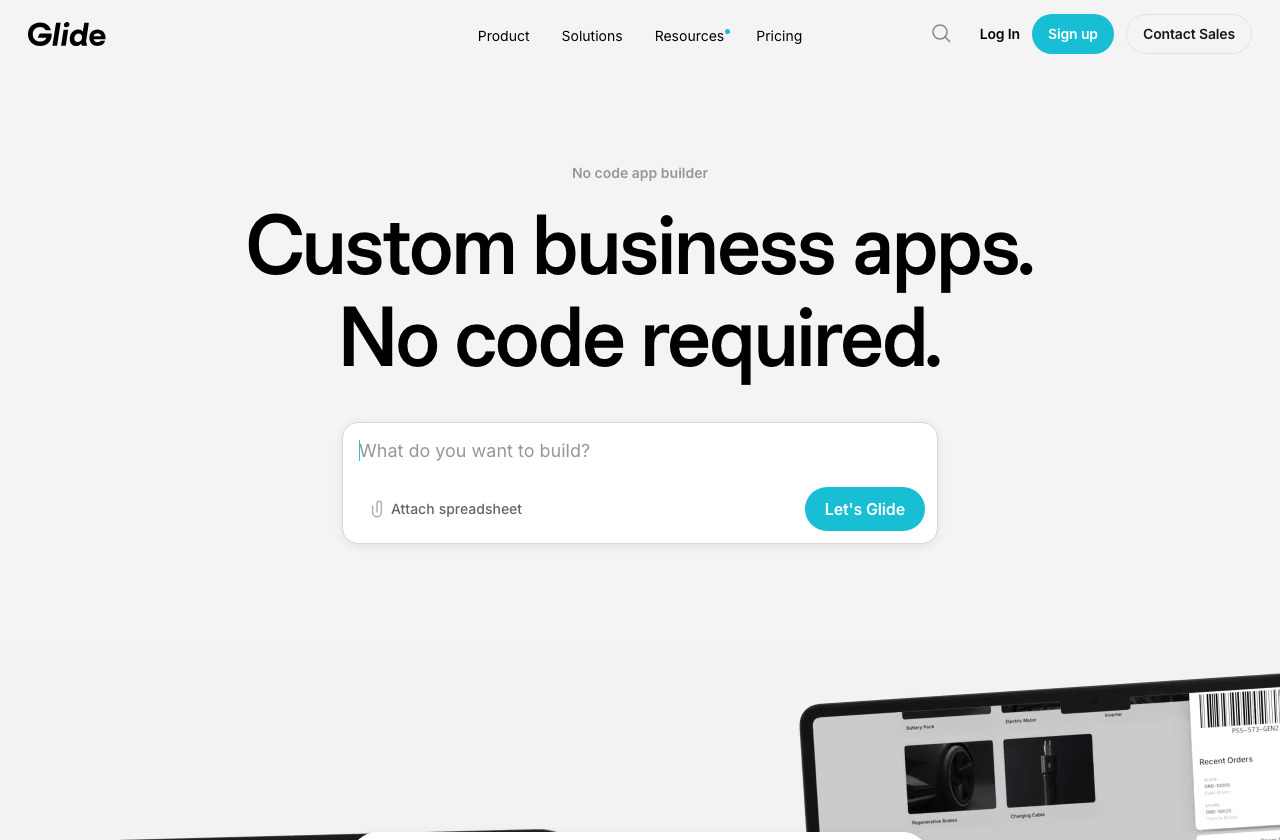
Build intelligent apps from spreadsheets—no code needed
Based on user reviews
Rating Distribution
Elena Vasquez
3 months ago
To be honest, Glide has been a game-changer for my team's inventory tracking. I've used it for about six weeks now, pulling data straight from Google Sheets into a clean web app that everyone can access on their phones. The drag-and-drop builder is so intuitive; I whipped up a dashboard with filters and real-time updates in under an hour, no coding needed. Compared to Zapier hacks we tried before, Glide's built-in workflows handle notifications and Stripe payments effortlessly, saving us at least 30 minutes a day on manual checks. The AI components are a nice touch too. I added a simple natural language search for quick lookups, which impressed my ops manager. Collaboration shines here; my colleague and I edited the same app live without issues. That said, it's not perfect for heavy customization. The templates look pro, but tweaking layouts gets rigid fast, and costs climb on the Maker plan if you add users. Still, for small business ops like ours, it's worth every penny over clunky spreadsheets. Highly recommend for anyone ditching manual processes.
Dr. William Bobos
Dr. William Bobos, with expertise in AI tools, has reviewed Glide for Productivity & Collaboration and rates it 4.0/5 based on 1 user review. The tool demonstrates particular strength for entrepreneurs who need AI tools capabilities in their operations.
Pricing: $0 – $249 / month(Updated December 2025)
Free plan $0/month, Explorer $19/month (annual) or $25/month (monthly), Maker $49/month (annual) or $60/month (monthly), Business $199/month (annual) or $249/month (monthly), Enterprise custom pricing
Usage Model: Projects — ensuring you only pay for what you actually use.
With Glide's free tier, entrepreneurs can explore productivity & collaboration features without financial commitment. Free users get access to core functionality that supports basic workflows and experimentation. For entrepreneurs requiring professional-grade productivity & collaboration capabilities, paid plans offer expanded features, better performance, and dedicated support.
Glide is a no-code platform that empowers operations teams to build modern, AI-powered web and mobile apps (PWAs) from data sources like Google Sheets, Excel, Glide Tables, and databases. It features a visual drag-and-drop interface, real-time updates, powerful workflows and automations, AI custom components, multiplayer collaboration, integrations with tools like Slack and Stripe, customizable templates, multimedia support, user permissions, and an automatic design system—without coding.[2][1][4][5]
Understanding the core functionality and approach of Glide.
Glide streamlines repetitive work with orchestrated flows and smart triggers. Teams stay focused on high-impact initiatives instead of manual follow-up. Integrations with Glide keep work connected.
Explore the powerful features that make Glide stand out.
Official API docs and clear auth flows—ideal for custom automations. Automation handles the repetitive work so teams can focus on strategy.
SDKs (e.g., JavaScript/TypeScript) help dev teams launch prototypes quickly.
Glide coordinates processes across teams so automation handles repetitive tasks. Automation handles the repetitive work so teams can focus on strategy.
Discover how different audiences leverage Glide for their specific needs.
Product teams lean on Glide to test features, gather feedback, and prioritize roadmaps using real data.
Workflows trigger automatically so stakeholders focus on higher-value work. Integrations with Glide keep work connected.
Discover more AI tools in related categories, platforms, and use cases.
Deepen your understanding of the concepts behind tools like Glide with our expert guides.
Understand core concepts like LLMs and Machine Learning.
Master search, filtering, and comparison to find the perfect tool.
Learn to craft effective prompts to command AI models.
Integrate AI into your daily workflows ethically and effectively.
See how Glide stacks up against similar alternatives in the market.

Create presentations, websites, docs & social instantly with AI—no design skills required.

Build full-stack apps at the speed of thought—AI-powered, browser-native, instantly deployed.
Explore these popular alternatives to Glide for your specific needs.
Take your tool to the next level with Featured placements, Academy mentions with high-authority backlinks, 48h Fast‑Track listing, Newsletter features to thousands of AI practitioners, and exclusive Data/API access for growth insights.
Use this page as a starting point to evaluate Glide alongside similar options. Our directory focuses on practical details that matter for adoption—capabilities, pricing signals, integrations, and real audiences—so you can shortlist with confidence and move from exploration to evaluation faster.
For a structured head‑to‑head, try the comparison view: Compare AI tools. To stay current with launches, model updates, and research breakthroughs, visit AI News. New to the space? Sharpen your understanding with AI Fundamentals.
Before adopting any tool, model your total cost at expected usage, verify integration coverage and API quality, and review privacy, security, and compliance. A short pilot on a real workflow will reveal reliability and fit quickly. Bookmark this site to track updates to Glide and the broader ecosystem over time.
Found incorrect information or have concerns about Glide? Let us know.
Looking for alternatives to Glide or similar tools? Use our AI-powered chatbot to discover the perfect solution for your needs.
